
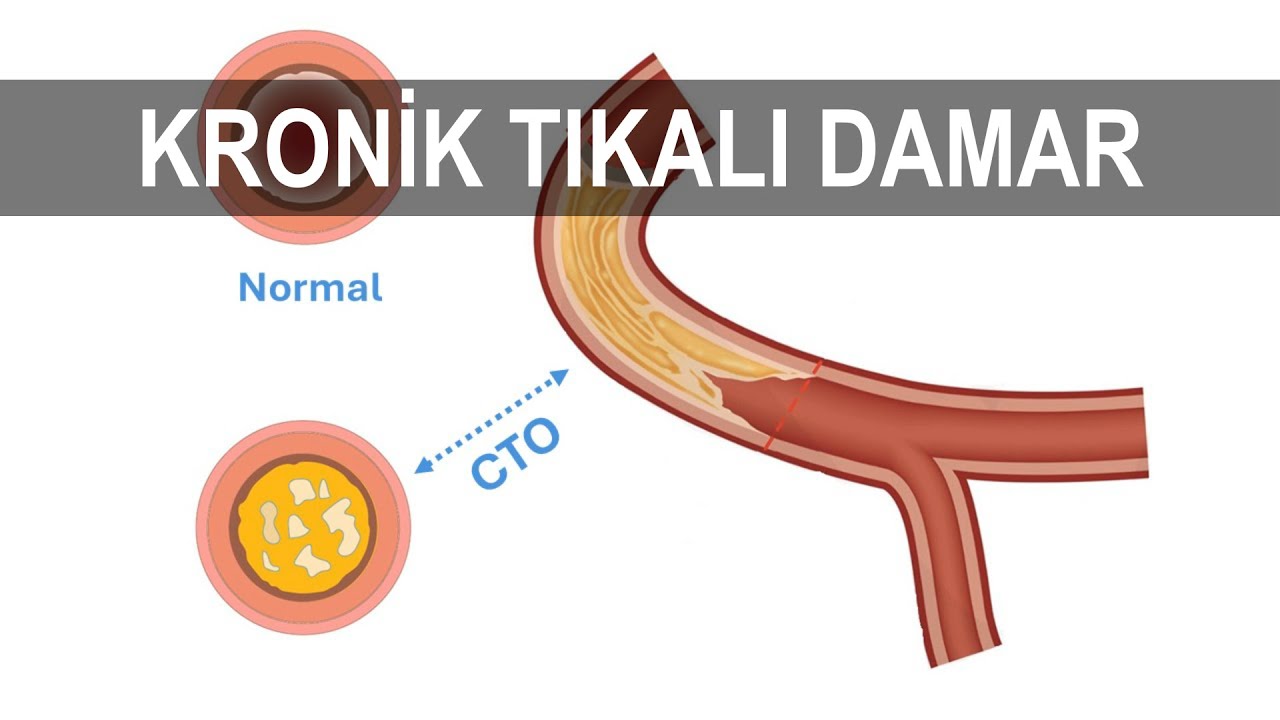
What is CTO (chronic total occlusion)?
If there is a “narrowing” in a blood vessel, there is still a small opening through which blood can flow, even if only in small amounts. A “blockage,” on the other hand, means the vessel is completely closed (100%). Thanks to the blood flow through the small opening in the narrowing, and thanks to the collateral blood vessels that develop in the case of a blockage, the affected heart tissue can receive enough blood (oxygen) to survive. A blockage can be soft or hard in structure. Blockages during a heart attack are often caused by a clot, so they are soft. In contrast, hard blockages result from the accumulation of fat and dense calcium over time. These chronic blockages, which have been present for more than three months, are called CTO (chronic total occlusion). Opening a CTO is more difficult than opening a narrowing or a soft blockage. Note: To better understand this section, first read “Stent“ page.

What is a completely blocked artery?
CTO (chronic total occlusion) is commonly known as a completely blocked artery.
What symptoms does CTO cause?
The symptoms of chronic arterial blockage are the same as those of arterial narrowing. It is not possible to distinguish between narrowing and blockage based on symptoms alone. Symptoms vary from person to person depending on the severity of the condition. Some people experience no symptoms at all. Some patients describe chest pain (angina) or a vague sense of discomfort while moving or under intense stress; others may report shortness of breath, fatigue, indigestion, or heartburn. These symptoms can range from mild to severe and generally do not occur at rest.
How is CTO treated?
CTO could previously be treated only with bypass surgery. Today, with the help of modern medical technology, these arteries can be opened using non-surgical methods without the need for heart surgery. These procedures are performed by interventional cardiologists. For a CTO to be opened non-surgically, the interventional cardiologist must have a specific professional interest and expertise in this field. Not every cardiologist prefers to deal with CTO; nor is there any obligation to do so. Above all, the CTO procedure requires an extensive training process that spans many years.
The non-surgical opening of a CTO is a more technical and distinct procedure compared to opening a simple arterial narrowing with a stent. As you can see in our classic stent video, a very thin wire must first be passed through the vessel to place the stent. However, unlike a narrowing (stenosis), there is no visible gap for the wire to pass through in a total occlusion. In fact, the CTO area is often so hard and calcified that it may not be possible to penetrate that region with an ordinary wire during the initial stage. In such cases, specialized equipment may be required, such as extension catheters, microcatheters, tapered and stiff wires, high-pressure balloons, cutting balloons, drill-like devices (rotablator), and shockwave lithotripsy devices (IVL). Additionally, specialized interventional techniques are applied.
The CTO opening procedure is usually first attempted from the front (antegrade). Sometimes, the procedure is performed from the front but by advancing through the vessel wall (ADR – Antegrade Dissection and Re-entry) rather than directly through the vessel lumen. However, an approach from the front is not always possible, and it may be necessary to reach the blocked area from the back, i.e., in the reverse direction (retrograde). In this method, the blocked area is penetrated from its relatively softer back side using collateral vessels that connect the part before the blockage to the part after it. Sometimes, these collaterals are located between different main arteries, and the back of the blockage is reached by entering through another vessel. For example, if a blockage in the left artery cannot be passed from the front, it can be bypassed by entering the right artery and advancing through the collaterals that connect the right and left vessels. Passing the wire through the occlusion is the most laborious stage of the CTO procedure. The entire process takes an average of two hours, though this duration can vary from case to case; it may be shorter or longer.


Is it necessary to clear every blocked artery?
In medicine, there are situations where a condition that seems intuitively logical to us may not provide the expected result at all due to certain unknown mechanisms. CTO is one of these. In high-quality scientific research (controlled, randomized, multicenter), the primary benefit of opening a CTO is the alleviation of the patient’s symptoms. In some cases, it has been observed to increase the heart’s pumping power; however, compared to drug therapy, it generally has not been seen to be very effective on the patient’s lifespan. The reasons for these results may include:
- Inappropriate patient selection. For example, performing the CTO opening procedure despite the heart tissue not being viable.
- Loss of potential benefits due to complications during the CTO procedure.
- Design or statistical errors in scientific research.
Therefore, exposing an asymptomatic individual with normal cardiac pumping power to the potential risks of a CTO procedure is not correct in terms of the risk-benefit balance.


Thanks to advancing technology, today, an experienced interventional cardiologist whose professional interest is complex procedures can open complex blockages, including CTOs, using stents. Stenting provides the same benefit as bypass surgery for most patients who have been recommended for bypass. In other words, both bypass surgery and stenting are equally effective for these patients; neither is incorrect. However, bypass surgery is still mandatory for some patients (See References).
For critical decisions such as treatment selection, we recommend seeking a second opinion from another physician. It is important to request that the latest scientific evidence for the recommended treatment be presented in an understandable language, along with its references.
Is the process of opening a CTO risky?
An experienced interventional cardiologist specializing in CTO can successfully reopen the artery in 9 out of every 10 CTO cases. However, as with any interventional procedure, there are certain risks associated with CTO procedures. Serious complications such as death, stroke, heart attack, and emergency heart surgery occur in 2 out of every 1,000 patients (0.2%) in conventional stenting, whereas they occur in 20 out of every 1,000 patients (2%) in CTO procedures. Because the CTO procedure takes relatively longer, radiation damage, contrast-induced kidney damage, and perforation of the coronary artery are more common than with conventional stenting.
You may be right to be concerned about these risks; but remember: These complications rarely occur. To put it another way, complications do not develop in 98 out of every 100 patients. What matters is whether the CTO opening procedure is truly necessary. If the decision has been made in accordance with current scientific data and guidelines, avoiding this procedure actually means the patient would have to continue living with a lower quality of life.
What happens if the CTO can’t be opened?
Once the specialized materials that were not available during the first procedure have been obtained, the same doctor may attempt to perform the procedure again. This time, they may be able to apply techniques they were unable to use during the first procedure and achieve success. In some cases, another doctor who has experience with different techniques and access to the specialized materials may recommend repeating the procedure and achieve success. In some cases, the case may be technically very challenging, but failure is not actually the issue. That is, because the procedure has taken a very long time (>3 hours), it is terminated before completion to prevent complications related to excessive radiation and contrast dye, and the remainder is performed in a separate session. Nevertheless, even under the best conditions, the vessel cannot be opened in 1 out of every 10 cases. However, as long as there are no complications, the inability to open the vessel does not worsen its condition compared to its initial state.
Prof. Dr. Şükrü Akyüz is an interventional cardiologist. His professional area of interest is the treatment of heart diseases using non-surgical methods. This includes the non-surgical opening of CTOs, utilizing techniques such as the retrograde approach (opening the vessel from the reverse direction).
References
- Galassi AR, Vadalà G, Werner GS, et al. Evaluation and management of patients with coronary chronic total occlusions considered for revascularisation. A clinical consensus statement of the European Association of Percutaneous Cardiovascular Interventions (EAPCI) of the ESC, the European Association of Cardiovascular Imaging (EACVI) of the ESC, and the ESC Working Group on Cardiovascular Surgery. EuroIntervention. 2024 Feb 5;20(3):e174-e184.
- Vrints C, Andreotti F, Koskinas KC, et al. 2024 ESC Guidelines for the management of chronic coronary syndromes. Eur Heart J. 2024 Sep 29;45(36):3415-3537.
- Brilakis ES, Mashayekhi K, Tsuchikane E, et al. Guiding principles for chronic total occlusion percutaneous coronary intervention. Circulation. 2019 Jul 30;140(5):420-433.
- Allana SS, Kostantinis S, Rempakos A, et al. The retrograde approach to chronic total occlusion percutaneous coronary interventions: Technical analysis and procedural outcomes. JACC Cardiovasc Interv. 2023 Nov 27;16(22):2748-2762.
- Stefanini GG, Alfonso F, Barbato E, et al. Management of myocardial revascularisation failure: An expert consensus document of the EAPCI. EuroIntervention. 2020 Dec 4;16(11):e875-e890.
- Brilakis ES. Manual of chronic total occlusion percutaneous coronary interventions: A step-by-step approach, 3rd ed. Philadelphia PA: Elsevier; 2023.