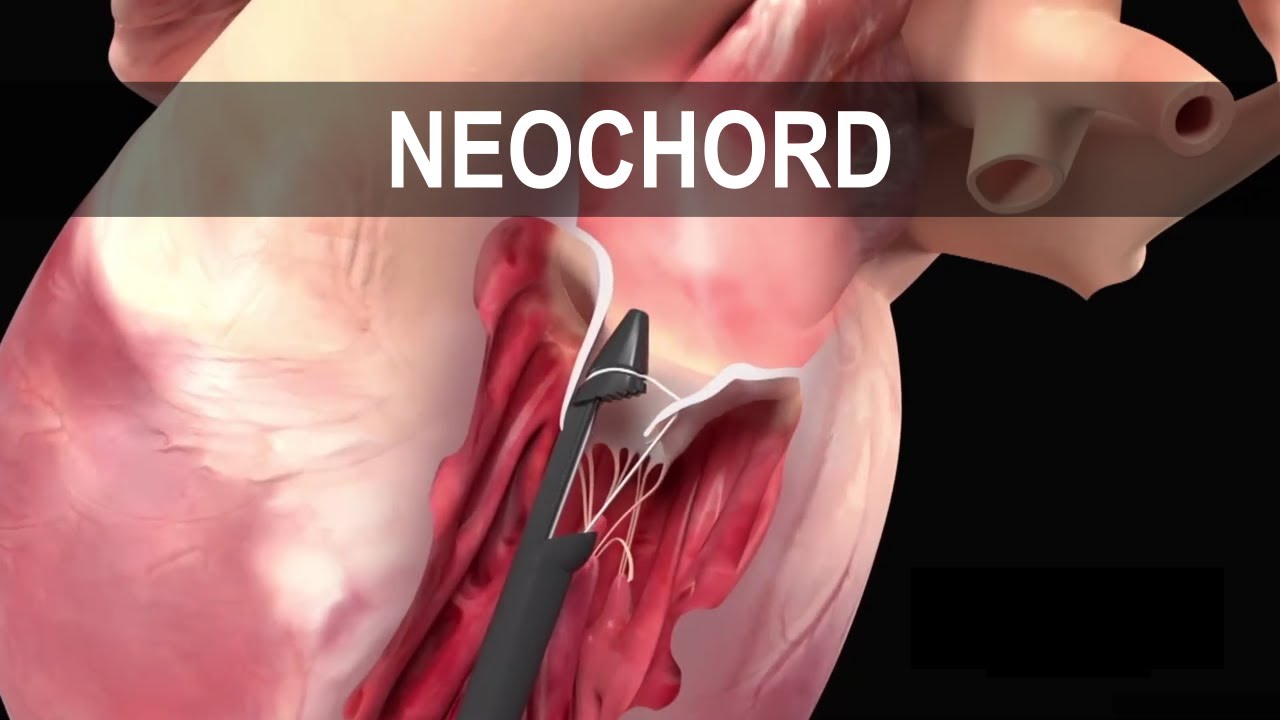
The strings that hold the leaflets of the mitral valve and resemble parachute cords are weak in some people. If these strings break for any reason, the mitral valve leaflets are left without support while the heart contracts, and blood leaks back into the left atrium. If this leakage is severe, the treatment that should normally be applied is the surgical repair of the valve. During surgery, artificial strings are sewn in place of the broken ones, and the leakage is eliminated. However, some patients carry a very high risk for surgery. These individuals may not be able to tolerate the heart being stopped during surgery and the use of a heart-lung machine during that period. In such cases, the NeoChord method can be applied to suitable patients. In this method, there is no need to stop the heart for the repair. Furthermore, while a longitudinal incision in the chest is required for classical surgery, this procedure is performed through a small hole opened in the chest. Now, let’s summarize how this procedure is performed: After the patient is put to sleep under general anesthesia, the rod of the device is inserted into the heart through a hole opened first in the chest, near the side of the left breast, and then into the apex of the heart. Thanks to special techniques, the heart is not stopped even during this stage of entering the heart. The mitral leaflet with the broken strings is captured by the device. To confirm the capture, both the transesophageal echo (TEE) and the device’s verification control are utilized. Then, artificial strings are attached to the mitral leaflet with sutures. The length of the strings is adjusted, and once the desired level of improvement in the leakage is achieved, the other ends of the strings are attached and fixed to the apex of the heart. Finally, the entry site is closed with a special technique, and the procedure is concluded.
Referanslar
Lasala JM, Rogers JH, eds. Interventional procedures for structural heart disease. Philadelphia PA: Elsevier; 2014.
Sievert H, Qureshi SA, Wilson N, eds. Interventions in structural, valvular, and congenital heart disease, 2nd ed. Florida FL: CRC Press; 2015.
WHY THIS WEBSITE?
Informing a patient in a short and clear language, backed by scientific data, is of great importance for treatment success. Because a well and correctly informed patient makes a conscious choice between the different treatment methods offered for such a vital organ as the heart (surgical or non-surgical). This way, hope increases, anxiety decreases, and the patient develops accurate expectations about the outcome. This website was created for this purpose by Prof. Sukru Akyuz, MD.