
What is a bifurcation?
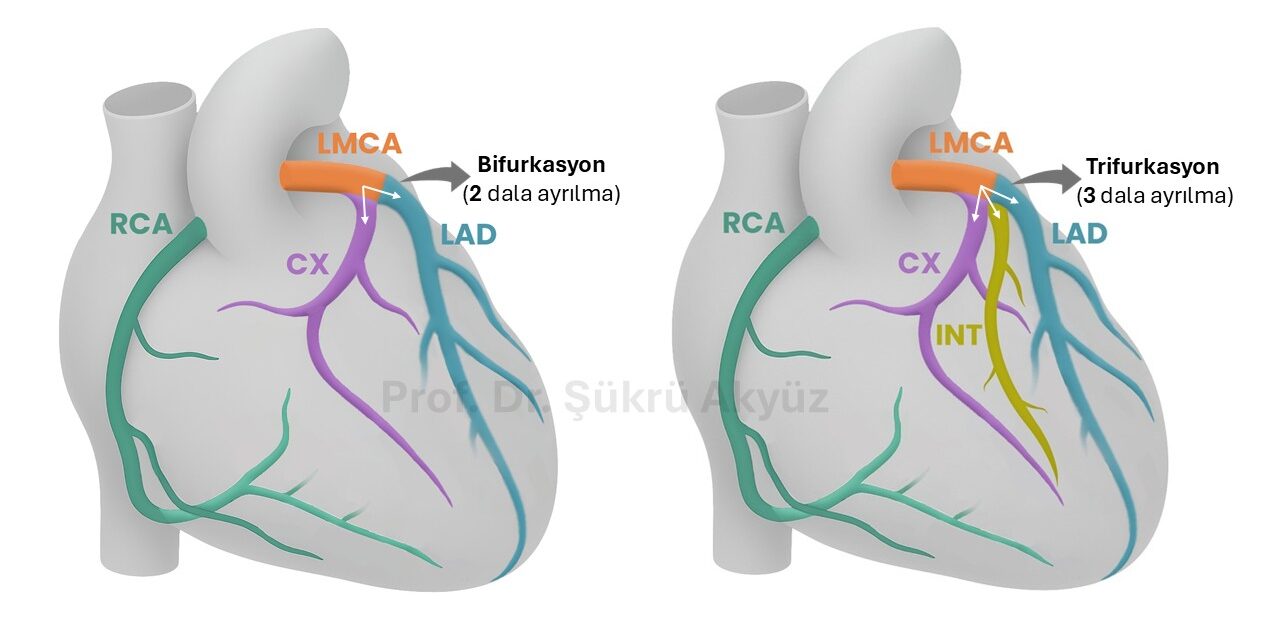
While carrying blood to the heart tissues, coronary arteries branch out in a manner similar to a tree trunk dividing into progressively smaller branches. The junction where a vessel splits into two separate branches is called a bifurcation. In medicine, bifurcation means “dividing into two, branching.” Stenting of narrowings located exactly at the bifurcation point of a vessel is more complex than stenting a region where the vessel runs a straight course. [Image of coronary artery bifurcation anatomy showing a main branch and a side branch] Note: While this section focuses on the left main coronary artery (LMCA), which is the heart’s largest branched vessel, what is described here generally applies to any branched vessel as well. Additionally, to better evaluate this section, I recommend first reading the “Stent“ page.
What does trifurcation mean?
If a vessel branches into three at the same point from birth, rather than two, it is called a trifurcation.
Why is the LMCA important?
In most people, approximately 80% of the blood supplied to the left side of the heart (the left ventricle), which pumps blood throughout the body, comes from the left main coronary artery (LMCA). Therefore, the LMCA is the most important artery in the heart.
Which is better for LMCA stenosis: a stent or bypass surgery?
LMCA stenoses are a more serious problem than all other vessel stenoses. This is because the LMCA is the largest heart vessel. In the past, bypass surgery was mandatory for LMCA stenoses; there was no other solution. Now, an experienced interventional cardiologist can alternatively open this vessel with a stent, including the bifurcation area. However, at this point, the Syntax score—which indicates the degree of complexity of the vascular occlusions and is calculated by observing the angiogram—is the determining factor. According to the recommendations in the ESC (European) guidelines shaped by scientific data; in most LMCA cases (those with a Syntax score <33), stenting provides similar long-term benefits to bypass surgery. In LMCA patients where additional complex stenoses are also present in other heart vessels (those with a Syntax score ≥33), bypass surgery is preferred as a large number of stents would be required. However, even if the Syntax score is ≥33, if surgery is too risky for the patient and therefore the patient or the surgeon is not considering surgery, then stenting is better than managing with medication alone and is the recommended method. [2026 update: The NOBLE trial, published in April 2026, demonstrated that at 10-year follow-up, percutaneous coronary intervention (stenting) and coronary artery bypass grafting showed equivalent efficacy across all risk groups, including patients with a SYNTAX score ≥33.]
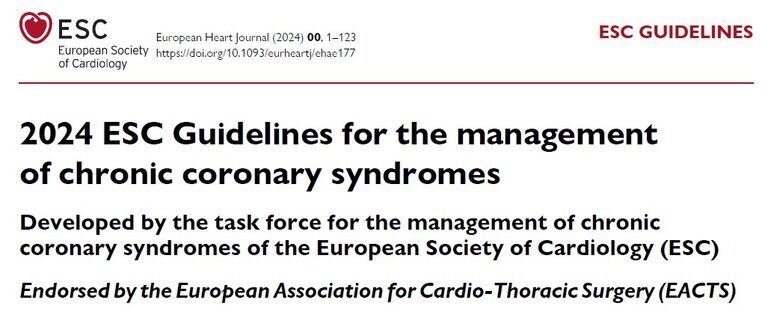
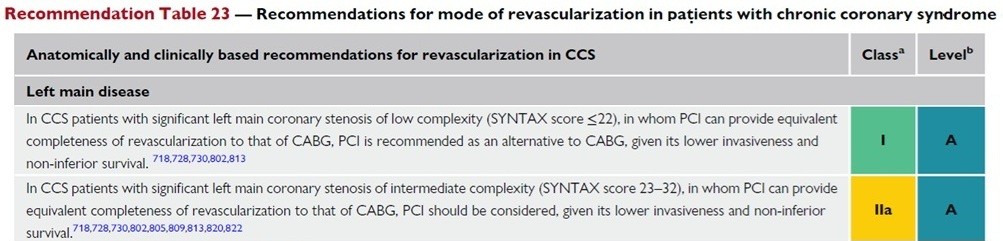

Thanks to advancing technology, today, an experienced interventional cardiologist whose professional interest lies in complex procedures can also open complex occlusions, including the LMCA and other branched vessels, with stents. In most patients for whom bypass surgery is decided, stenting provides the same benefit as bypass surgery. In other words, for these patients, both bypass surgery and stenting are equally effective; neither is incorrect. However, in some patients, bypass surgery is still necessary (See References).
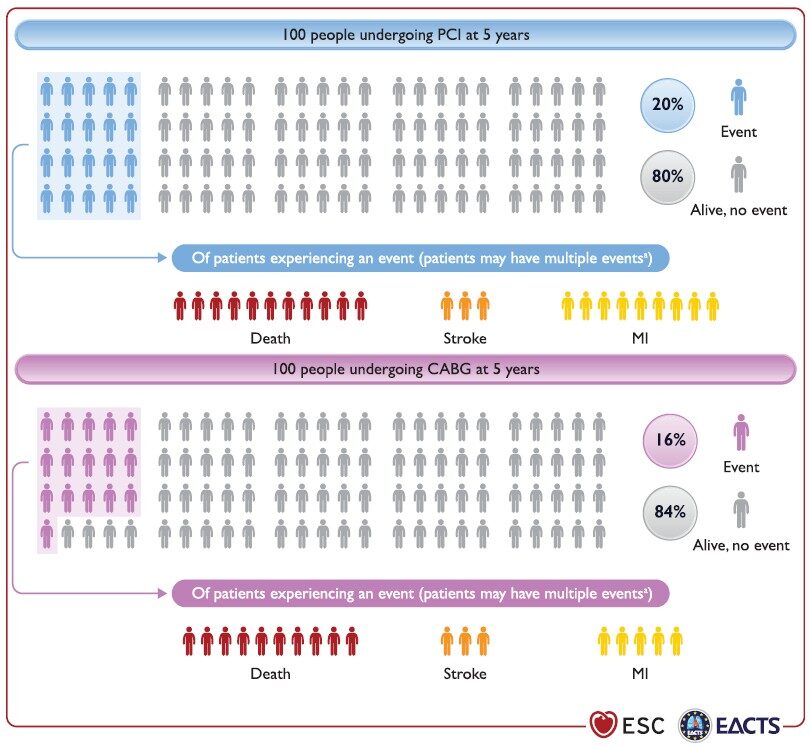
Below, you see the comparison from the latest “Joint ESC/EACTS review on the revascularisation of LMCA (those with a Syntax score <33)” published by the ESC (European Society of Cardiology) and EACTS (European Association for Cardio-Thoracic Surgery). This figure is intended to help patients better understand the outcomes between the two methods. As can be understood from this figure, within 5 years, no problems develop in 84 out of every 100 patients undergoing bypass surgery; with stenting, no problems develop in 80 people. In other words, the difference is 4 out of every 100 patients. Ultimately, the patient evaluates the significance of this 4% difference in events from their own perspective and has the right to make the final choice based on the pros and cons of stenting versus bypass surgery. The duty of physicians is to respect the patient’s decision (See References).
We recommend seeking a second opinion from another physician for serious decisions such as treatment selection. It is important to request that the most up-to-date scientific evidence for the recommended treatment be presented in understandable language, along with its references.
How is a stent placed in a bifurcated artery?
For a narrowing in any branched vessel in the heart to be opened with a stent, this subject must be within the interventional cardiologist’s professional field of interest. Not every cardiologist prefers to deal with complex case procedures; nor is there any such obligation. Above all, complex stenting procedures require a long training process and years of experience. Some branched vessels require the use of flexible stents because their branches have different diameters. For example, the part of the stent extending into one of the two branches might need to be 3.0 mm, while the proximal part might need to be able to expand to 4.5 mm. The expansion characteristics of each stent brand, and even different diameters of the same brand, vary. In other words, stents of the appropriate brand and diameter for branched vessels must be available in the hospital’s medical supply inventory. Stenting a straight, non-branched section of a vessel consists of several stages: the wire is passed through the narrowing, the narrowing is dilated with a balloon, the stent is implanted, and a balloon is inflated again inside the stent to ensure it is properly seated against the vessel wall, concluding the procedure. However, stenting a branched vessel is a multi-stage complex procedure that requires the use of specialized materials and the application of specific techniques, where the doctor’s manual dexterity and experience play a crucial role. Which interventional technique is chosen and the details of these techniques are academic subjects; but briefly, they depend on:
- Is the patient’s condition an emergency (heart attack) or not?
- Which technique is the doctor more experienced in performing?
- Is the narrowing only in the main branch, or is there also a narrowing in the side branch?
- What are the diameters of the branched vessels in mm?
- What is the angle between the branching vessels in degrees?
What are the techniques for stenting bifurcated arteries?
One of the following branched vessel stenting techniques is selected based on the answers to the questions above (See References):
- Provisional technique
- “T” technique
- TAP technique
- DK-miniCulotte technique
- DK-miniCrush technique
Provisional Technique
“T” Technique
TAP Technique
DK.miniCulotte Technique
DK.miniCrush Technique
Examples of our bifurcated vessel stenting cases
References
- Vrints C, Andreotti F, Koskinas KC, et al. ESC Guidelines for the management of chronic coronary syndromes. Eur Heart J. 2024 Sep 29;45(36):3415-3537.
- Lawton JS, Tamis-Holland JE, Bangalore S, et al. ACC/AHA/SCAI Guideline for coronary artery revascularization. J Am Coll Cardiol. 2022;79:e21-e129.
- Byrne RA, Fremes S, Capodanno D, et al. 2022 Joint ESC/EACTS review of the 2018 guideline recommendations on the revascularization of left main coronary artery disease in patients at low surgical risk and anatomy suitable for PCI or CABG. Eur J Cardiothorac Surg 2023 Aug 1;64(2):ezad286.
- Burzotta F, Lassen JF, Louvard Y, et al. European Bifurcation Club white paper on stenting techniques for patients with bifurcated coronary artery lesions. Catheter Cardiovasc Interv. 2020 Nov;96(5):1067-1079.
- Loh PH, Lassen JF, Jepson N, et al. Asia Pacific consensus document on coronary bifurcation interventions. EuroIntervention. 2020 Oct 9;16(9):e706-e714.
- Burzotta F, Louvard Y, Lassen JF, et al. Percutaneous coronary intervention for bifurcation coronary lesions using optimised angiographic guidance: the 18th consensus document from the European Bifurcation Club. EuroIntervention. 2024 Aug 5;20(15):e915-e926.
- Holck EN, Holm NR, Hildick-Smith D, et al. Percutaneous coronary intervention versus coronary artery bypass grafting for unprotected left main stenosis: 10-year final results from the randomised, open-label, non-inferiority NOBLE trial. Lancet. 2026 Apr 4;407(10536):1374-1382.
- Brilakis E. Manual of percutaneous coronary interventions: A step-by-step approach, 1st ed. Philadelphia PA: Elsevier; 2021.