

What is an aortic aneurysm?
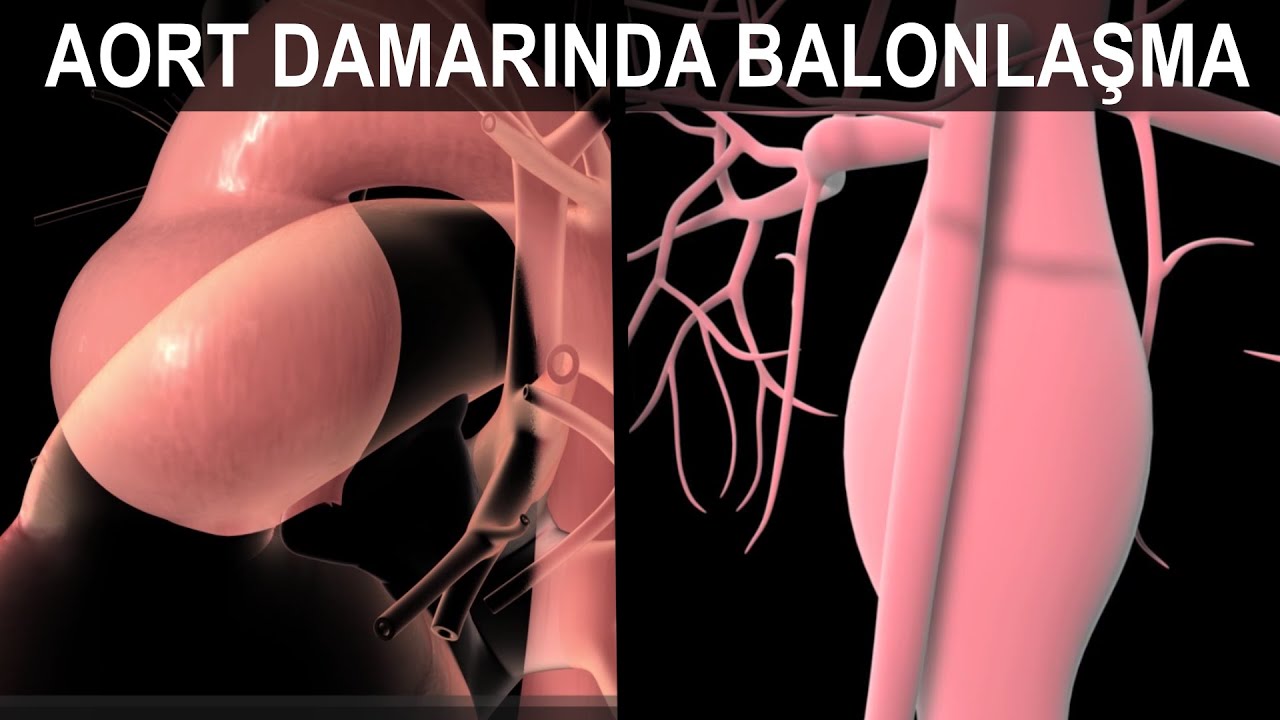
The aorta (aorta) is the largest vessel in the body and the main artery that distributes the blood pumped from the heart to the body. The aorta has thick walls that can withstand blood pressure. However, in certain medical conditions or genetic situations, these walls can weaken. Blood pressure within the vessel, especially if it is high, can cause an aneurysm (ballooning) in the weakened or damaged walls. An aneurysm can occur anywhere in the aorta: at its beginning, middle, or end. If an aortic aneurysm becomes too large, it can tear (aortic dissection) or rupture (aortic rupture). With early diagnosis and treatment, this growth in the aorta can be slowed or even prevented.

What are the symptoms of an aortic aneurysm?
- Most aortic aneurysms do not cause any symptoms. They are mostly detected by chance during computed tomography (CT), MRI, or ultrasound examinations performed for another reason. In some patients, however, they can cause symptoms. If they cause symptoms, this depends on the location and size of the aneurysm:
- Difficulty swallowing or pain during swallowing as a result of the aneurysm pressing on the esophagus
- Difficulty breathing as a result of pressure on the windpipe (trachea) or lung
- Hoarseness as a result of pressure on the nerves of the vocal cords
- Swelling of the face, neck, or arms as a result of pressure on the main vessels that bring blood from the upper part of the body to the heart
- A feeling of pain or throbbing in the abdomen
Unfortunately, sometimes the first symptom can be the tearing or rupture of the aorta. In general, the larger the aneurysm and the faster it grows, the higher the risk of these emergencies occurring. In an emergency, many different symptoms can occur, but the most common symptom is very severe pain in the chest, abdomen, or back.
What are the causes of aortic aneurysms?
- Genetic causes: The risk of aortic aneurysm is high in certain genetic diseases. These include bicuspid aortic valve, Marfan syndrome, Ehlers-Danlos syndrome, Loeys-Dietz syndrome, Turner syndrome, and other familial aortic aneurysm syndromes. These diseases can be passed on to children at certain rates. The condition called bicuspid aortic valve is particularly important because it is the most common congenital heart disease. In this disease, the aortic valve is congenitally composed of two leaflets instead of three. In these individuals, the structure of the aorta is also prone to being loose and weak, and thus susceptible to aneurysm. Narrowing or leakage of the valve also exerts additional pressure on the aortic wall. Therefore, bicuspid aortic valve is frequently accompanied by aortic aneurysm.
- Uncontrolled hypertension
- Smoking
- Trauma
- Vasculitis (Vascular inflammation)
How is an aortic aneurysm treated? What is EVAR? What is TEVAR?
- Surgery: If an aortic aneurysm has grown significantly, intervention is required due to the risk of tearing or rupture. One of the intervention options is surgery. In surgery, the ballooned area is cut open. A tube (graft), usually made of polyester, is placed inside the aneurysm. This graft is sewn to the vessel such that one end corresponds to the segment before the aneurysm and the other end to the segment after it, and the vessel walls are then closed back up. Blood enters through one end of the graft and exits through the other without entering the ballooned area. Thus, blood pressure cannot reach the inside of the aneurysm, and risks such as tearing or rupture are reduced.
- Non-surgical method: For most patients with an aneurysm in the abdomen or chest, a graft (more accurately, a stent-graft) can alternatively be placed using non-surgical methods. Currently, aneurysms at the beginning of the aorta (ascending aorta) cannot be treated with non-surgical methods; however, it is estimated that in the near future, aneurysms in this region will also be treatable non-surgically thanks to developing technology. Non-surgical treatment of abdominal aneurysms is called EVAR; non-surgical treatment of aneurysms in a specific part of the chest (descending aorta) is called TEVAR. In these methods, no incision is made in the chest or abdomen; the procedure is performed via the groin (leg) artery: First, the groin area is numbed so the patient feels no pain. A needle is used to enter the leg artery, and a long wire is sent into the aorta. Then, the catheter carrying the polyester-covered stent-graft is advanced into the aorta by sliding it over this wire. The position of the stent-graft is adjusted within the aneurysm region. The stent-graft is released from the tip of the catheter via a mechanism outside the patient and expands spontaneously into its factory-manufactured shape. Due to the branches leading to the right and left legs, additional stent-grafts may sometimes be required. Ultimately, blood is prevented from entering the aneurysm.

At what size does an aortic aneurysm require surgery or EVAR/TEVAR?
The likelihood of problems with aortic dilations up to 4.0 cm is extremely low. However, the risk increases as the aortic diameter increases. In most patients, surgery, EVAR, or TEVAR is required when the aortic diameter reaches 5.0-5.5 cm. At this value, the risk of aneurysm rupture or perforation is higher than the risk of intervention (surgery or EVAR/TEVAR risk). Therefore, intervention on the aneurysm is now necessary. However, it should be remembered that every patient is different, and in some cases, the decision to intervene may be made earlier or later. For example, if genetic reasons are involved (Marfan syndrome, etc.) or if the aneurysm is found to be growing very rapidly during medical follow-ups, earlier intervention may be necessary. Similarly, since a person who is 1.50 m tall will naturally have a proportionally smaller aorta, the decision to intervene may be made at smaller diameters.
What should people with aortic aneurysms be aware of?
Taking the following precautions can slow down or even stop the growth of an aneurysm:
- Keeping hypertension and high cholesterol under control; if prescribed, using medications regularly (In particular, using beta-blocker group drugs is thought to be beneficial. Uncontrolled hypertension is the most significant factor causing the growth of an aneurysm.)
- Adopting healthy eating habits (Low-salt, Mediterranean-style diet, etc.)
- Quitting smoking
- Increasing physical activity (walking, etc.)
- Avoiding situations that cause straining, such as constipation or lifting very heavy loads (Straining increases blood pressure within the aorta momentarily)
- Focusing on stress management (This may not always be possible and may require medication)
References
- Mazzolai L, Teixido-Tura G, Lanzi S, et al. ESC Guidelines for the management of peripheral arterial and aortic diseases. Eur Heart J. 2024 Sep 29;45(36):3538-3700.
- Isselbacher EM, Preventza O, Hamilton Black J 3rd, et al. ACC/AHA Guideline for the diagnosis and management of aortic disease. Circulation. 2022 Dec 13;146(24):e334-e482.
- Libby P, Bonow RO, and Mann DL, eds. Braunwald’s heart disease: A textbook of cardiovascular medicine, 12th ed. Philadelphia PA: Elsevier; 2022.