

Table of Contents
What is a medicated balloon?
In recent years, balloons, like stents, have been developed in models coated with a special medication. These are referred to as “medicated balloons”.” (DCB: Drug-Coated Balloon) is called. BWhen the balloon is inflated, the medications penetrate the vessel wall and thus prevent excessive tissue growth, which plays an important role in re-clogging the vessel. Medicated balloons are similar to medicated stents (DES: Drug-Eluting Stent) on the contrary, they do not leave a metal structure inside the vessel. In this way, vessel, It does not lose its elasticity; that is, it can continue to contract and expand as needed. They also allow for a shorter duration of additional blood thinning medication. However, even if a medicated balloon procedure is planned, the result is that in approximately 1 in 4 cases, the vessel re-dilates immediately after ballooning. (collapses/recoil) or more cracks in the vessel than expected (dissection) formation of a scaffold after ballooning (stent) should be emphasized.
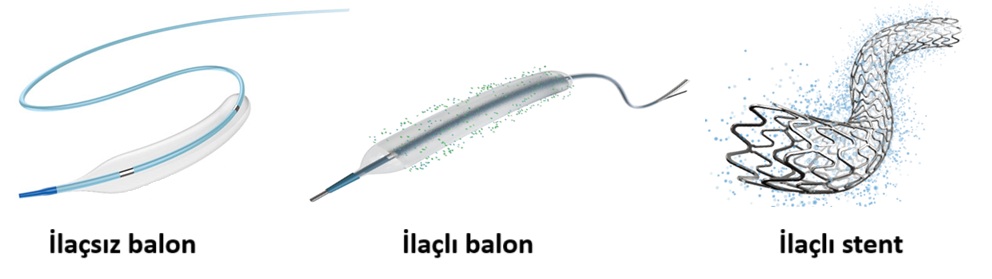
Is a medicated balloon or a medicated stent better?
In the absence of sufficient data, the healthiest and most scientific approach is to continue with treatments that have known and proven results. Because science works with evidence. For example, dissolvable stents were very popular until a few years ago. Although there are no comparative scientific studies with non-melting (metallic) drug eluting stents, the fact that these stents can dissolve and leave no material behind Theoretical it was very plausible. In fact, it even made more sense than medicated balloons. Therefore, most patients and doctors thought that it was better to use dissolvable stents than non-dissolvable stents. However, when the results of high-quality comparative scientific studies were published, it became clear that this was not the case at all. In some patients, dissolvable stents did not fit properly in the vessel wall, ruptures occurred in the stent structure and some parts of the stent did not dissolve partially. Because of these problems, patients with dissolvable stents had a higher risk of heart attack and death due to sudden vascular occlusion than patients with drug-eluting stents. As a result, dissolving stents were withdrawn from use. Let's keep this information in mind and see what the current scientific data says about medicated balloons, which have been increasingly used in recent years:
- Medicinewith balloons medicineleaking balloons it's better.
- Medicinewith balloons are as effective as medicated stents in thin vessels. Slim In vessels with a diameter of ≤2.75 mm (≤2.75 mm), obstruction occurs more frequently than in larger vessels because there is not enough space for tissue growth to cover the stent. However, even in these thin vessels, medicated balloons are not better than medicated stents, but they are not worse either, i.e, equal They are highly effective. Thin veins are the group where medicated balloons are best used, and I (Prof. Dr. Şükrü Akyüz) use them frequently in these cases.
- In the future, a possible bypass surgery if necessary, at the place where the vessel (graft) to be added will be connected (anastomosis), a medicated balloon is preferred over a medicated stent. Because the stent may prevent the graft from connecting to the vessel.
- In cases where a certain part of the vessel is not on the surface of the heart but in the muscle tissue (intramyocardial course) Using a medicated balloon is theoretically more logical than using a stent. This is because, if a stent is inserted, each time the heart contracts, it may crush the stent, causing it to break over time and eventually block the stent.
- If a previously implanted stent narrows over time due to excessive tissue growth (ISR: In-stent restenosis) reapplying a medicated stent (stent in stent) to this area is usually better than applying a medicated balloon. We say “generally” because some studies presented at scientific congresses have reported that some medicated balloons are as effective as medicated stents in both large vessels and in-stent occlusions (For details, we have to wait for the publication and interpretation of the studies making these claims in quality scientific journals). In the case of recurrent in-stent occlusions (recurrent ISR), drug-eluting balloons are preferred because, theoretically, the third layer of stent is expected to further occlude the vessel.
- For other vessel types [3 mm and larger main vessels (including LMCA), bifurcated vessels where two stents are required, completely occluded vessels (CTO)...], there are no high-quality (large, randomized and controlled) scientific studies comparing medicated balloons with medicated stents. Therefore, their use in these situations is not routinely recommended. Their ultimate efficacy and safety will be determined by the results of future scientific studies. Perhaps, even in these cases, drug-eluting balloons will indeed be as good as or even better than drug-eluting stents and will enter routine use. Perhaps, in most cases, they will not be found to provide a better result than drug eluting stents and will remain in limited use (See. References).
To summarize:
- Thin veins Medicated balloon and medicated stent are equally effective.
- Blockage of a previously implanted stent: A medicated stent (stent in stent) is generally superior to a medicated balloon.
- Other vessel types: There is no data yet; the answer is not clear.
Can a medicated balloon save a patient from a stent or bypass?
LMCA veya 3 ana damar tıkanıklıklarında güncel bilimsel kılavuzlar bypass ameliyatı veya kompleks stentleme önermektedir. Bu damarları ilaçlı balonlar da genellikle açar; ama, mevzu sadece “damarı açmak” değildir. Evet, damar balonla kısmen bile olsa açıldığında (örneğin; %90 darlık, %50’ye gerilediğinde) kan akımı artacağı için hastanın şikayetleri ilk başta geçer. Ama, “Will the vein stay open in the long run?” The question is much more important. Unfortunately, however, it is not uncommon for some social media accounts and websites to claim that the medicated balloon can open the vessels without even stenting, i.e. without leaving any metal behind, thus saving patients from complex stenting or bypass surgery. This is contrary to scientific guideline recommendations and medically incorrect because it is potentially error-prone. So, are we sure that the fate of medicated ballooning in these cases will not be disappointing in the long term, like the fate of dissolving stents in the past? If future comparative quality scientific studies prove that drug-eluting balloons are as good as drug-eluting stents in complex cases, of course, most interventional cardiologists, myself included, would prefer drug-eluting balloons over drug-eluting stents. Because it is much easier to perform a medicated balloon than a complex stenting procedure. After all, ballooning is basically the act of inflating a balloon; it is not as dependent on the physician's knowledge, experience, dexterity and specialized materials as stenting.

For serious decisions, such as the choice of treatment, we recommend that you seek a second opinion from a different physician. It is important that you request that the most up-to-date scientific evidence for the proposed treatment is presented in understandable language, with references.