

Table of Contents
- Sol atriyal apendiks kapatma nedir?
- LAA kapatma nedir?
- LAA kapatma işlemi kimlere yapılır?
- LAA kapatma işlemi deneysel bir tedavi yöntemi midir?
- What is the probability of the procedure being successful?
- What are the risks of LAA closure?
- İşlem öncesi hangi tetkikler yapılır?
- LAA'yı ameliyatla kapatmak daha garanti bir yol değil midir?
- How long does the LAA closure procedure take?
- Is the procedure performed by stopping the heart, as in heart surgery?
- LAA kapatma işlemi sırasında ağrı duyulur mu?
- When will I be discharged after the procedure?
- LAA kapatma cihazlarından en iyisi hangisidir?
- Will the LAA device move?
- Cihaz, vücutta hissedilir mi?
- Cihaz, vücutta ömür boyu kalacak mı?
- İşlemden sonra kan sulandırıcı ilaç kullanılacak mı?
- LAA kapatıldıktan sonra dikkat edilmesi gerekenler nelerdir?
- LAA kapatma vakalarımızdan örnekler
- References
Sol atriyal apendiks kapatma nedir?
Kalbin üstteki iki odasına kulakçık; alttaki iki odasına da karıncık denir. Hem sağ hem de sol kulakçığın cep benzeri çıkıntıları vardır. Sol taraftakine “sol atrial apendiks” adı verilir; “sol kulakçık çıkıntısı” anlamına gelir. English, left atrial appendage (LAA). A clot can form in the LAA as a result of a common rhythm disorder called atrial fibrillation (AF). This clot may one day dislodge and become dislodged as the heart pumps the blood. kan damarları yoluyla beyne gidebilir ve kan akımını kesip felce (inme) neden olabilir. Sol atriyal apendiks kapatma işlemi, pıhtı oluşmasını engellemek ve hastayı felçten korumak için bu cebin ameliyatsız yöntemle kapatılmasıdır.
LAA kapatma nedir?
LAA kapatma ya da LAA kapama, sol atriyal kapatma işleminin kısa adıdır.
LAA kapatma işlemi kimlere yapılır?
This procedure is performed on patients who have an arrhythmia called AF and need to take blood thinners to prevent clots from forming, but for some reason their use of these medications is risky. For example, patients who have had a cerebral hemorrhage or stomach bleeding while taking blood thinners are a suitable patient group for this treatment. Starting these patients on blood thinners again carries the risk of bleeding again, while not starting them carries the risk of clots forming inside the heart. This is where the LAA closure procedure comes into play. The logic of the procedure is based on both preventing clot formation and eliminating the need for lifelong blood thinners. Sometimes, despite the patient taking the appropriate dose of blood thinners, a clot still forms. In this case, LAA closure can also be performed. Some professions may also consider LAA closure in case of AF. Examples include professions with a high risk of bleeding due to physical trauma, such as firefighting, or professions that pose a life-threatening risk to other people in the rare event of bleeding, such as piloting. Elderly people who frequently fall down and experience physical trauma or patients who cannot take blood thinners due to allergies, side effects, forgetfulness, etc. are also suitable groups for LAA closure.
LAA kapatma işlemi tüm AF hastalarına uygulanabilir mi?
Hayır. Mekanik yapay kalp kapağı ya da romatizmal kalp kapağı darlığı olan AF’li hastalarda LAA kapatma işleminin yapılması uygun değildir.
LAA kapatma işlemi deneysel bir tedavi yöntemi midir?
This procedure is not an experimental treatment method. It has FDA and CE approval. It has been applied to more than 250,000 cases all over the world so far.
What is the probability of the procedure being successful?
Genel olarak başarı oranı %95’ten fazladır.
What are the risks of LAA closure?
Her girişimsel işlemde olduğu gibi LAA kapatma işleminde de bazı riskler bulunmaktadır. Cihazın yerinden çıkması, cihazın üzerinde pıhtı oluşması ve ölüm gibi ciddi sorunlar toplamda her 100 kişiden 2’sinde meydana gelir. Ancak, bu olasılık işlem yapılmazsa oluşabilecek felç riskinden çok daha azdır.
Bu riskler nedeniyle endişelenmekte haklı olabilirsiniz; ama unutmayın: Bu komplikasyonlar nadiren gelişirler. Önemli olan, bu işlemin gerçekten gerekli olup olmadığıdır. Eğer, güncel bilimsel verilere ve kılavuzlara uygun bir şekilde karar verilmişse bu işlemden kaçınmak kendinizi felç riskine 3 kat daha fazla maruz bıraktığınız anlamına gelir (See. References).
İşlem öncesi hangi tetkikler yapılır?
- Blood test: For the control of other diseases such as anemia, kidney failure and infection.
- ECG and rhythm Holter: Kalpte AF denilen ritim bozukluğunun olup olmadığının kesinleştirilmesi için.
- CT (Computed tomography): Kalpteki cebin (LAA) anatomik olarak kapatmaya uygun olup olmadığının belirlenmesi ve işlem planının yapılabilmesi için.
- TEE (ECHO through the esophagus): To determine whether the sac is anatomically suitable for closure, to prove that there is no clot in the sac and to plan the procedure.
LAA'yı ameliyatla kapatmak daha garanti bir yol değil midir?
Conclusion. On the contrary, for technical reasons, it is less likely that the LAA can be successfully closed by surgery. Also, having surgery just for this purpose means taking more risks. However, if the patient is undergoing heart surgery for another reason, then it is advisable to close the LAA at the same time during surgery.
How long does the LAA closure procedure take?
Usually 1.5 hours. However, this may be longer in some complex LAA anatomies.
Is the procedure performed by stopping the heart, as in heart surgery?
No, the heart does not need to be stopped.
LAA kapatma işlemi sırasında ağrı duyulur mu?
No. The procedure is performed either under sedation or under general anesthesia. The difference is that under general anesthesia, a tube is inserted into the patient's respiratory tract and a respirator supplies the patient with air; under sedation, no breathing tube is inserted, the patient is not connected to a respirator, the patient is just put to sleep and breathes on his/her own. In both techniques, the patient is given drugs that prevent the patient from feeling pain during the procedure. General anesthesia (intubation) is more comfortable for the patient.
When will I be discharged after the procedure?
Most patients stay in hospital for a day and then are discharged.
LAA kapatma cihazlarından en iyisi hangisidir?
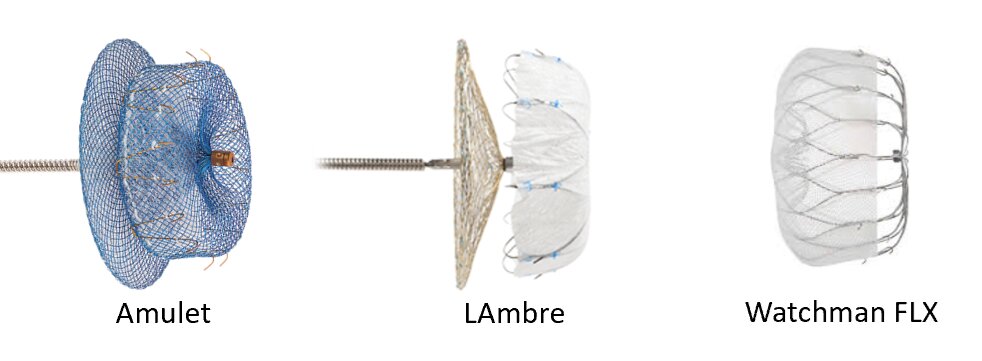
Tüm dünyada olduğu gibi ülkemizde de sıklıkla Amulet, LAmbre veya Watchman FLX marka cihazlar kullanılır. Üçü de kalitelidir ve birinin diğerine bilinen önemli bir üstünlüğü yoktur. Seçim, doktorun hangi cihazda tecrübeli olduğuna ve LAA anatomisine göre belirlenir.
Will the LAA device move?
No, it is not. There have been cases reported in the literature where it appears to have been displaced, but this is rare.
Cihaz, vücutta hissedilir mi?
No.
Cihaz, vücutta ömür boyu kalacak mı?
Yes. It is not possible to remove the device back.
İşlemden sonra kan sulandırıcı ilaç kullanılacak mı?
Yes. Usually two blood thinners are used for the first 2-3 months. Then, one of the two blood thinners is stopped and the other is used alone until the 6th month. After the 6th month, blood thinners are usually not used.
Burada, kafa karıştıran bir detaydan kısaca bahsedelim: Sağlıkçı olmayanlar arasında hepsi “kan sulandırıcı ilaç” diye adlandırılsa da AF denilen ritim bozukluğu için kullanılan kan sulandırıcı ilaçlar, LAA kapatma işleminden sonra kullanılanlardan farklı olan ilaçlardır. Ayrıca, işlem sonrası kullanılan ilaçlar ömür boyu değil, genellikle sadece 6 aylığına kullanılırlar. Dolayısıyla, hasta kan sulandırıcı ilaçlara bağlı kanama riskini ömür boyu değil, 6 aylığına almış olur. Üstelik bu risk, daha hafif kan sulandırıcı ilaçlar kullanıldığı için daha düşüktür. 6. aydan sonra genellikle hiçbir kan sulandırıcı ilaç kullanılmayacağından ilaca bağlı kanama riski de artık ortadan kalmış olur.
LAA kapatıldıktan sonra dikkat edilmesi gerekenler nelerdir?
- LAA kapatıldıktan sonra ilk 1 ay yarışmalı veya ağır sporlardan kaçınılmalıdır.
- LAA kapatıldıktan sonra cihazın üzerinin dokuyla kaplanması 6 ay kadar sürebilir. Bu süreçte, kana karışan mikroorganizmalar direkt kan yoluyla cihaza bulaşıp infektif endokardit adı verilen ciddi bir enfeksiyona yol açabilirler. Bu nedenle, ilk 6 ay boyunca diş çekimi veya başka bir organdan ameliyat olmak gibi kanamalı operasyonlardan önce antibiyotik alınması gerekir. 6 aydan sonra böyle bir önleme ihtiyaç yoktur. Ama, nadiren, cihazın köşesinden kalıcı kan kaçağı devam edebilir; bu durumda kanamalı operasyonlar öncesinde antibiyotik alınması her zaman önerilir.
- Nikel-titanyum alaşımından yapılmış olan bu cihazların metalik yapıları gereği emarın (MRI) manyetik alanından etkileneceği zannedilir. Oysa, bu cihazların manyetik alandan etkilenme özellikleri zayıftır; bu nedenle 3 Tesla dahil emar çekilmesinde sakınca yoktur.
LAA kapatma vakalarımızdan örnekler
References
- Joglar JA, Chung MK, Armbruster AL, et al. ACC/AHA/ACCP/HRS Guideline for the diagnosis and management of atrial fibrillation. Circulation. 2024 Jan 2;149(1):e1-e156.
- Van Gelder IC, Rienstra M, Bunting KV, et al. ESC Guidelines for the management of atrial fibrillation developed in collaboration with the European Association for Cardio-Thoracic Surgery (EACTS). Eur Heart J. 2024 Sep 29;45(36):3314-3414.
- Glikson M, Wolff R, Hindricks G, et al. EHRA/EAPCI expert consensus statement on catheter-based left atrial appendage occlusion – an update. Europace. 2020 Feb 1;22(2):184.
- Landmesser U, Skurk C, Tzikas A, et al. Left atrial appendage closure for stroke prevention in atrial fibrillation: current status and perspectives. Eur Heart J. 2024 Aug 21;45(32):2914-2932.
- Reed GW, Nakhla S, Miyasaka R, et al. Left atrial appendage occlusion: Expanding indications and new developments. Structural Heart. 2025:100354
- Akyuz S, Avci II, Karabay CY, et al. How to safely occlude left atrial appendage with a thrombus inside? Anatol J Cardiol. 2020 Jan;23(1):49-52.